Who Owns Your Factory's Data? (Matt Chang on FINTECH.TV)

Chang Robotics
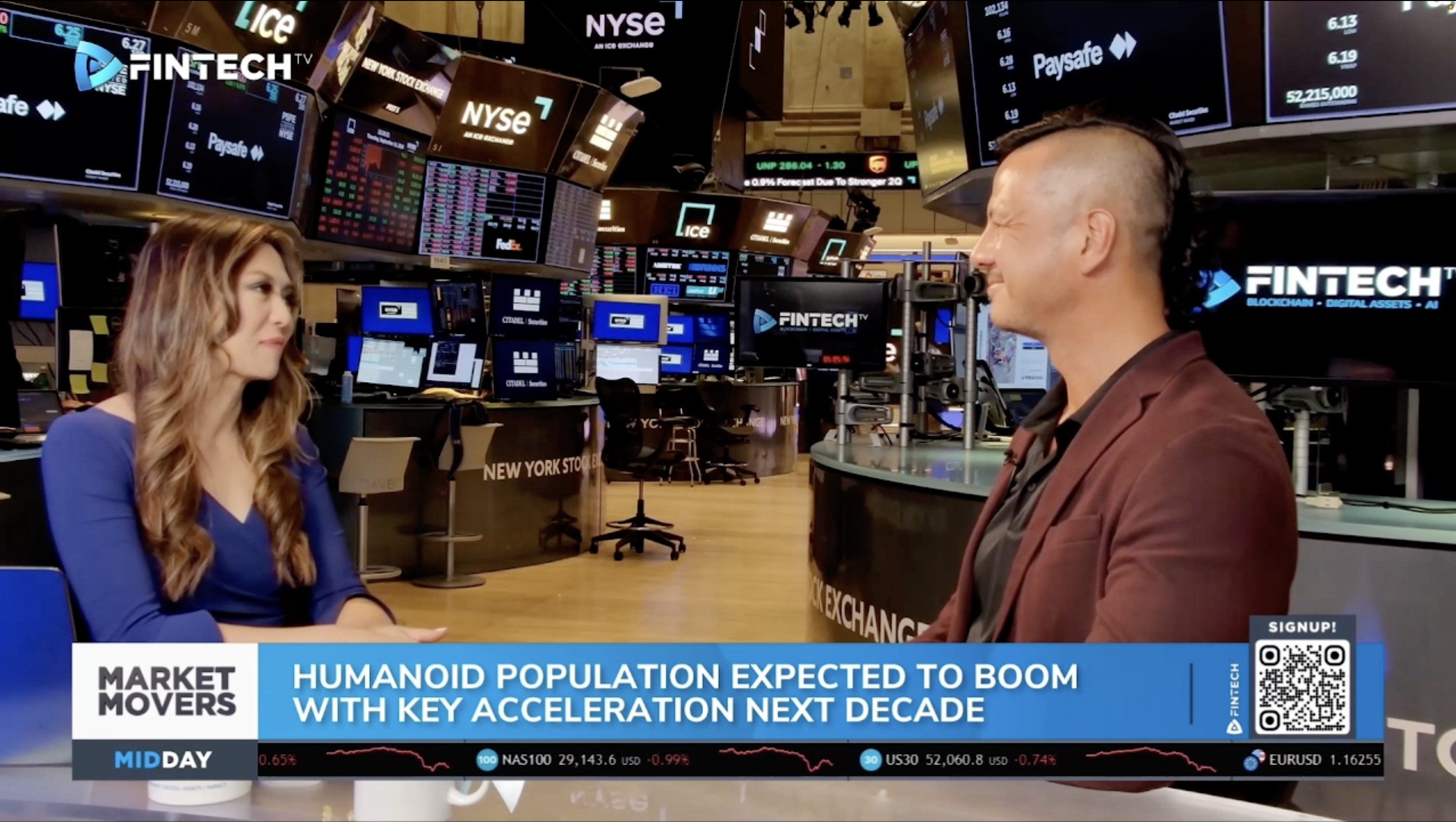 Fig. 01Articles and Media
[
Most conversations about AI on the factory floor start with what the robot can do. Fewer start with where the data goes.
Matt Chang, founder and CEO of Chang Robotics, was at the New York Stock Exchange this week for an interview with FINTECH.TV anchor Remy Blaire about physical AI. When asked about his vision for the company, he did not start with robots, he started with privacy.
"We're very big into privacy. That's probably the number one thing."
Then he drew the line plainly:
"What we don't believe is that that information should then be sent away from your home or from your factory site to another company's data center where they store it, repackage that information, and perhaps sell that data model to another company. We think companies and households deserve to own their data and have sovereignty over that."
Why a robot is a data question
Earlier in the segment, Matt gave a very clear definition of physical AI:
"Physical AI is really just putting machine learning into robots. So, back in the original days of robots, when you might have seen them in a car plant, for example, they were linear programming. So you tell the robot what to do, and it repeats the same task. The promise of physical AI is that the robot can look at its environment or sense its environment, and then interpret what it's supposed to do next."
A robot that senses its environment and decides what to do next has to collect data to decide.
The operating record of your plant could leave the building.
Most plants are not ready for it yet
Matt's read on where American facilities actually stand:
"The reality is, most of our facilities in America, whether it be e-commerce or manufacturing or healthcare and hospitals, they don't have the base infrastructure to have data to even install AI and have it be meaningful."
His answer is to build that layer first:
"We want every customer of ours equipped with the base infrastructure of digital intelligence. So we have good data collection. That means that as the AI models are evolving, we can continue to upgrade them to the latest models, so they have the latest and greatest."
Collection comes first, then models. Matt's point is that the data layer is what lets a plant keep up as the models change.
What this looks like in practice
If you are scoping an automation project, put the data questions alongside the performance questions and get the answers in writing. Where is the data stored? Who has access to it? Does it leave your site, and if so, where does it go? Can the vendor use it to train models it sells to someone else? What happens to all of it when the contract ends?
Any integrator should be able to answer those questions. Ask them early, because the answers are much harder to change after a system is installed.
Chang Robotics is vendor-agnostic. We choose the technology that fits your floor, your people, and your operations. On the data question, our position is the one Matt gave on air.
Restoring American manufacturing, one factory at a time.
Watch the full segment on FINTECH.TV.
Matt Chang was interviewed by anchor Remy Blaire at the New York Stock Exchange.
Chang Robotics
Keep Reading
Related Articles
 01
01Chang Robotics at the USA Rare Earth Groundbreaking in Blacksburg
On September 9, 2026, USA Rare Earth broke ground on a new rare earth metal and magnet manufacturing facility in Blacksburg, South Carolina. Chang Robotics is part of the partner team bringing that facility online.We were on site for the ceremony. What follows is what is being bu
Sep 15, 2026Read → 02
02Stop Trying To Retain Employees
Lasting loyalty is built much earlier. It's built the moment an employee realizes, 'This company is investing in me.' For decades we've been focusing on employee retention. Now it's time to work on becoming the kind of company people don't want to leave.
Sep 1, 2026Read → 03
03Here’s how America builds again
Discover how Factory 5.0 automation is revolutionizing American manufacturing.
Jul 20, 2026Read →
Done Reading? Let's Talk About Your Floor.
Tell us what you're trying to solve. We'll tell you what automation can and can't fix.