The Evolution of Modern Manufacturing

Matthew Chang, PE
Founder
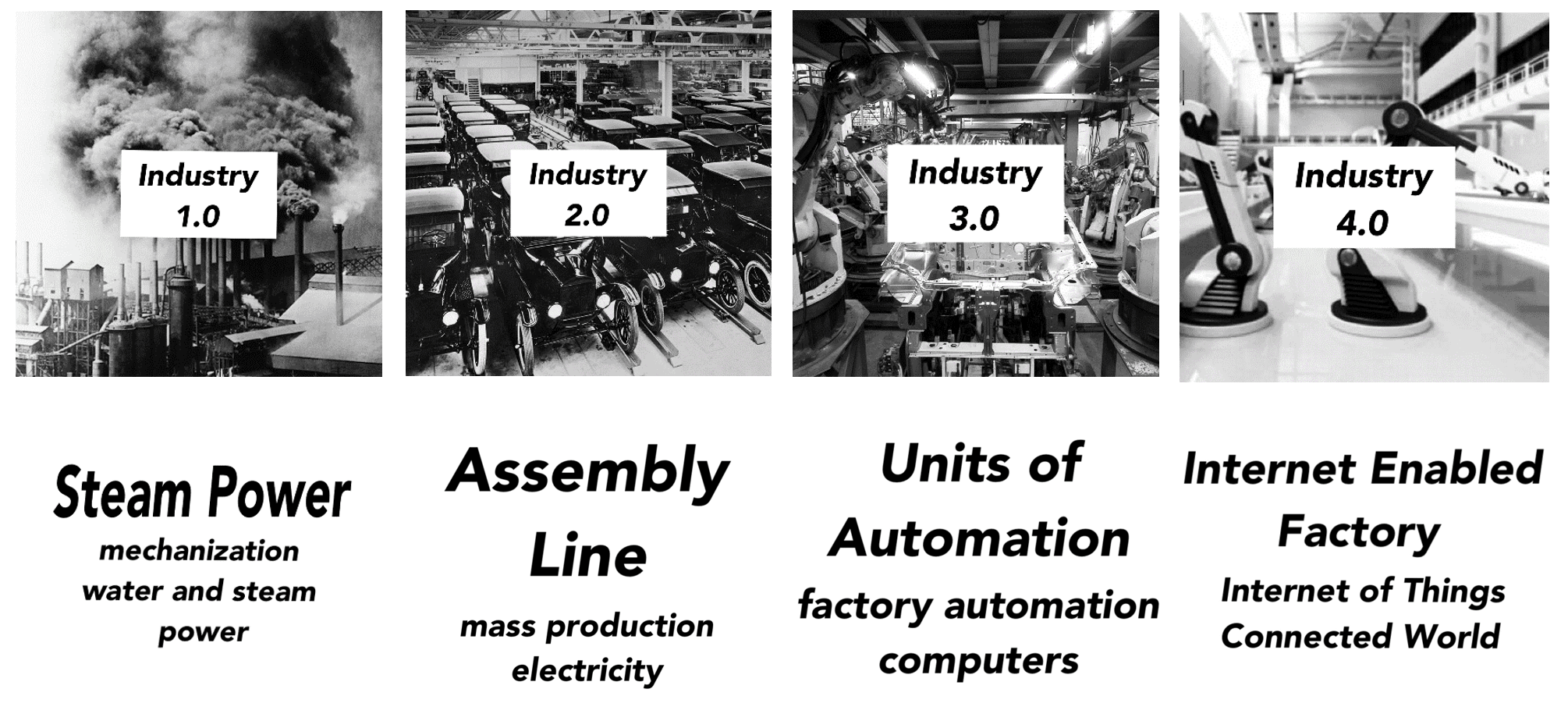 Fig. 01Articles and Media
The manufacturing industry is rapidly changing as new technologies and software are being created and implemented by companies around the country. Ideas once thought of as outrageous and far-fetched are now being overcome by innovators in the industry. It is a competitive race for manufacturers and distributors to stay up to date and a head of the game with the latest technology in production, manufacturing, and distribution. This trend in the industry is known as the 4th Industrial Revolution or Industry 4.0. The transformation caused by our current industrial revolution is as great as the first with an even greater ability to change the standard of living for the human race. Here’s a look at the evolution of manufacturing:
Industry 1.0 – Steam Power (and hydro power) coupled with mechanization unleashes production capabilities that are no longer reliant on the strength of men and horses.
Industry 2.0 – Assembly lines and electrification allow for mass production and consistent quality. The cost of finished goods drops rapidly.
Industry 3.0 – Units of Automation (aka Islands of Automation) allow for robotic production and highly accurate and repetitive production of products.
Industry 4.0 – Internet enabled factory just means the factory is connected to the internet. All devices speak and deep learning (artificial intelligence) becomes pervasive. Data is integrated along the supply chain from raw material to customer.
The progression from the first industry until now shows the always changing and progressing industry of manufacturing and distribution. The most alike are industries 3.0 and 4.0. Industry 4.0 is essentially a more advanced version of Industry 3.0 connecting automation to the internet. This connection unlocks connectivity to websites, internet of things, limitless data capture, and business intelligence. Additionally, Industry 4.0 can leverage many of the manufacturing assets (units of automation) from Industry 3.0 by adding machine upgrades for real time sensing and data flow.
Transitioning to the Internet Enabled Factory is essential for success in the world of e-commerce. Changing industry trends, consumer taste, and fashion trends have led to the need for a highly responsive and flexible manufacturing infrastructure. The more fixed and dedicated a manufacturing plant is, the less adaptable to changing trends it is.
Since the first boom of innovation in the late 1760’s until now the change in innovation has been consistent and ever present. As innovators clear the way for manufacturers and distributors there will always be a faster, more efficient way to do industry. Internet of Things and Internet Enabled Factory is the newest, most innovative era we find ourselves in but what will the next 100 years bring?
Matthew Chang, PE
Founder
Matthew founded Chang Robotics in 2017 and brings two decades in advanced manufacturing, with engineering projects across 20 disciplines.
Keep Reading
Related Articles
 01
America can manufacture at cost-parity with China
Automation shrank labor’s share of unit cost, which changes what the US is competing on. Matthew Chang on why parity with China is reachable, and what has to be true about the workforce for it to happen.
Oct 20, 2026Read → 02
Nobody Is Building a New Plant Without Automation (Matthew Chang on Cheddar)
Matthew Chang on Cheddar: automation used to need a financial justification, and in 2026 it is the base case. What that changes about new plants, and about who works in them.
Oct 13, 2026Read → 03
There Is Not Enough Skilled Labor for the Factories Being Built (Matthew Chang with Jane King)
Every industry vertical is expanding at the same time, the skilled workforce to staff those plants does not exist in the numbers required, and supply chains are stretching. Matthew Chang’s advice to any manufacturer weighing automation is to get the plan lined out now, because the speed at which you move is a decision you can make later.
Oct 13, 2026Read →
Done Reading? Let's Talk About Your Floor.
Tell us what you're trying to solve. We'll tell you what automation can and can't fix.