How Do the China Tariffs Impact U.S. and Chinese Manufacturing?

Matthew Chang, PE
Founder
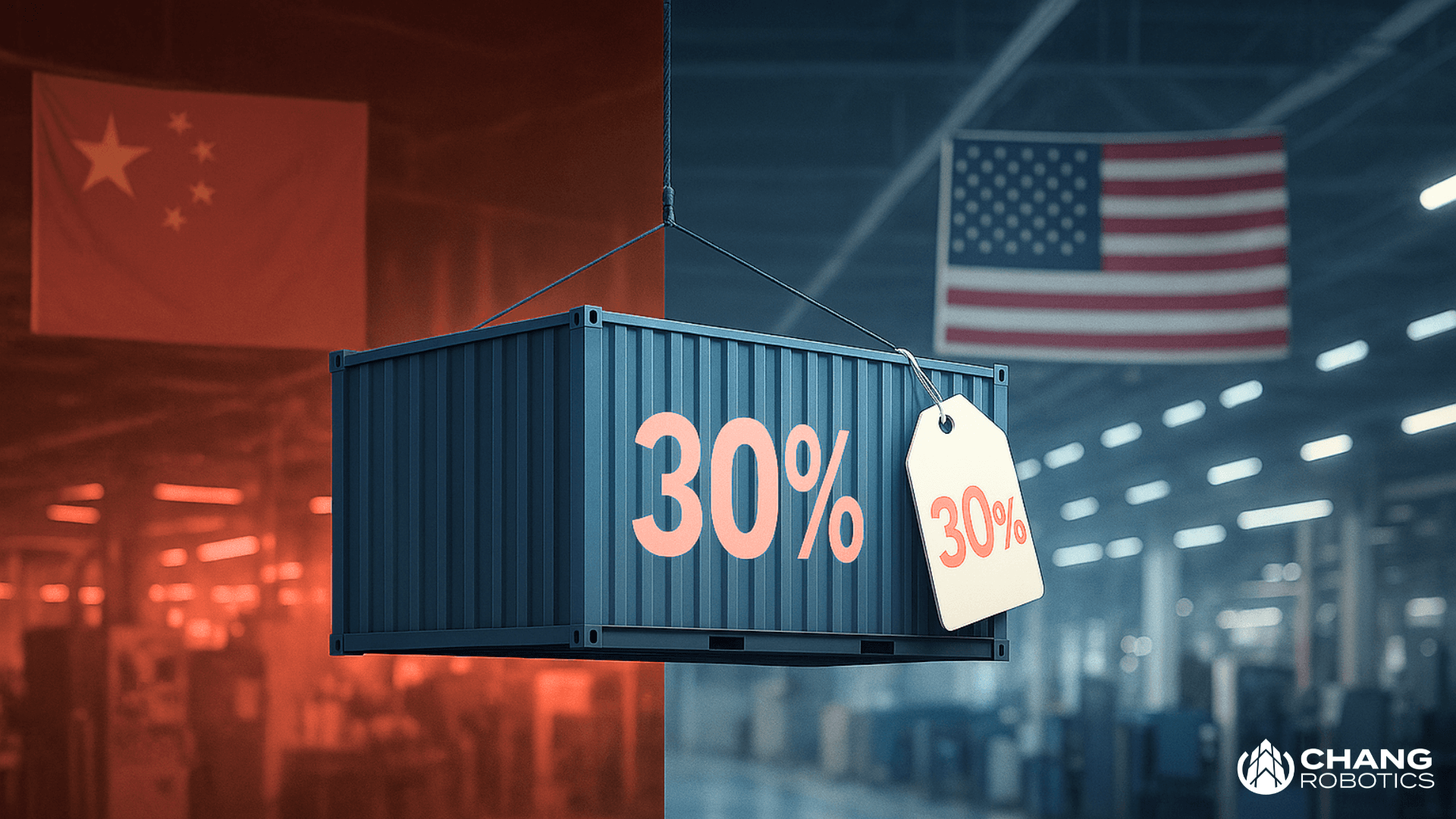 Fig. 01Articles and Media
Matthew Chang, Chang Robotics Founder
Two reporters asked me this question today. I know this topic well—I previously opened an engineering and construction business in China and am a registered engineer there.
Our primary business, Chang Robotics, is based in Jacksonville Beach, Florida, where I lead an engineering and robotics company. I'm also a licensed engineer in the U.S. We source and import robots globally and integrate them into robotic systems for American manufacturing and supply chain companies. One of our key sourcing countries is China, and many of our partners either manufacture there or are headquartered there.
I have on-the-ground experience designing and building factories in China, and I continue to import products from the region. The impact of the current tariffs, now exceeding 100%, is devastating for Chinese manufacturers. Many factories producing goods for the U.S. cannot simply pivot to serve other global markets. They’re purpose-built and tooled specifically for sectors like U.S. automotive, aerospace, and computing. These components don’t translate easily to other markets, and global demand can’t absorb the excess capacity. As a result, the tariffs are catastrophic for China’s economy, hurting manufacturing, industrial real estate, supply chains, and logistics infrastructure.
Some Chinese producers have resorted to “tariff washing”—trans-shipping goods to other Asian countries, relabeling them, and then shipping them to the U.S. to sidestep higher tariffs. In those cases, they may pay just 10% via intermediary companies. This is a common workaround. Meanwhile, direct-to-consumer shipping from China, especially via e-commerce, has largely halted due to postal restrictions and high tariff rates on container loads and declared goods.
With the tariff rate shifting to 30%, we’ll see a renewed, though cautious, wave of orders from China. Supply chains are slow to reconfigure, and many U.S. companies simply don’t have alternatives yet. Using a basic example—transistors or light bulbs manufactured in China—companies will still place orders to meet demand forecasts, but with tight control to avoid overstock. A 30% tariff still significantly impacts profitability. While orders may resume, they won’t rebound to levels the Chinese economy is hoping for. That 30% still acts like a parachute slowing U.S. demand and encourages domestic companies to seek alternative suppliers.
At 30%, the tariff is high enough to warrant global sourcing shifts or even a return to U.S. production. Chinese producers may experience a brief reprieve, but layoffs, surplus inventory, and lower productivity will persist. They won’t return to pre-tariff production levels.
It’s also worth noting that Chinese manufacturing typically operates on very slim margins—often slimmer than those in the U.S. Their economy lacks the cushion to absorb slowdowns while keeping people employed and industrial leases paid. The impacts on industrial real estate, shipping volumes, and factory staffing will continue under the 30% rate.
In short, while the lowered tariff provides temporary relief for Chinese producers and a more manageable situation for U.S. importers, 30% is still a major disruptor. We’ll continue to see products routed through third countries, goods under-declared at customs, and a slowdown in Chinese production.
What does this mean for U.S. manufacturers?
This situation accelerates the momentum behind Made-in-America manufacturing. That trend is here to stay. But for large-scale U.S. manufacturers, turning operations around quickly isn’t possible.
As I’ll share in an upcoming Fast Company column, there are 292,825 existing factories in the U.S. Of these, 846 employ over 1,000 people. Some of these are Chang Robotics clients. We’re helping them navigate the shift to domestic manufacturing while implementing automation—efforts that are both massive and multi-year, but also incredibly exciting.
We believe in America’s future. We're driven not just by the opportunity to rethink how we make things, but by the chance to strengthen America’s position as a leader in advanced, Made-in-America manufacturing.
For U.S. manufacturers preparing for what’s next, if you haven’t yet connected with the team at Chang Robotics, reach out through our website. Now is the time to plan strategically for what’s ahead—and act. Our door is open.
Matthew Chang, PE
Founder
Matthew founded Chang Robotics in 2017 and brings two decades in advanced manufacturing, with engineering projects across 20 disciplines.
Keep Reading
Related Articles
 01
America can manufacture at cost-parity with China
Automation shrank labor’s share of unit cost, which changes what the US is competing on. Matthew Chang on why parity with China is reachable, and what has to be true about the workforce for it to happen.
Oct 20, 2026Read → 02
Nobody Is Building a New Plant Without Automation (Matthew Chang on Cheddar)
Matthew Chang on Cheddar: automation used to need a financial justification, and in 2026 it is the base case. What that changes about new plants, and about who works in them.
Oct 13, 2026Read → 03
There Is Not Enough Skilled Labor for the Factories Being Built (Matthew Chang with Jane King)
Every industry vertical is expanding at the same time, the skilled workforce to staff those plants does not exist in the numbers required, and supply chains are stretching. Matthew Chang’s advice to any manufacturer weighing automation is to get the plan lined out now, because the speed at which you move is a decision you can make later.
Oct 13, 2026Read →
Done Reading? Let's Talk About Your Floor.
Tell us what you're trying to solve. We'll tell you what automation can and can't fix.