As North American Manufacturing Surges, Who Wins?

Matthew Chang, PE
Founder
 Fig. 01Articles and Media
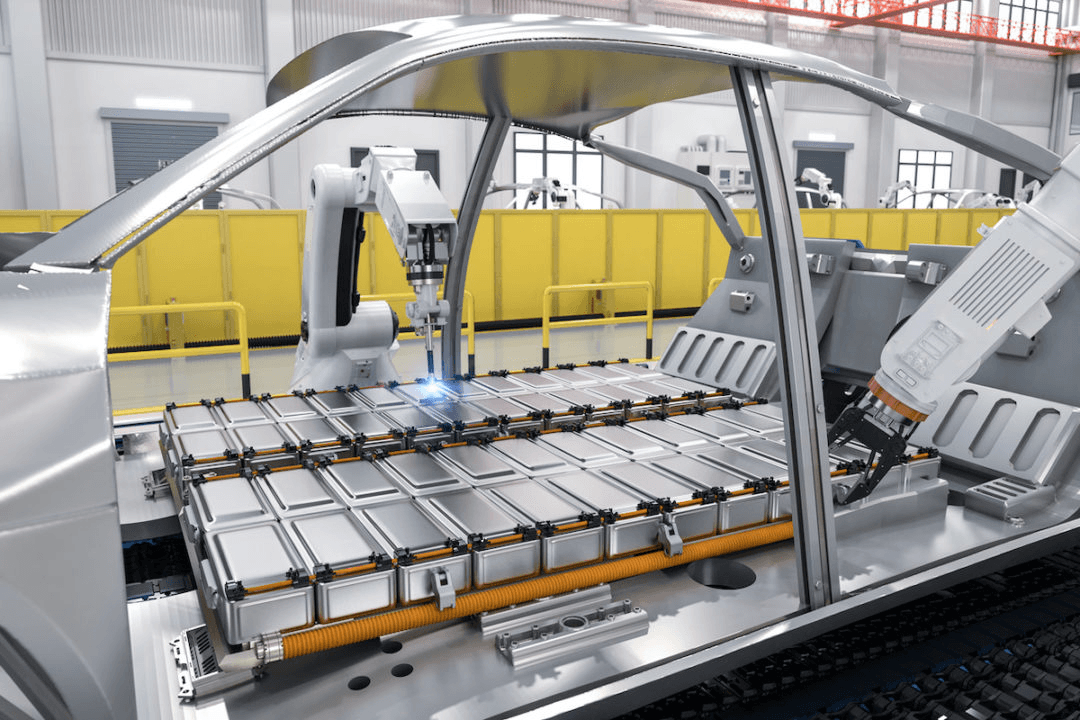
Regardless of one’s opinion of the state of the U.S. economy, the data is clear: after several decades of progressive offshoring operations to save on labor costs, U.S. and North American manufacturing is progressively coming back home.
There are varied reasons for the shift, including geopolitical shocks, wars, increasing labor costs and a deteriorating trade relationship with China. While full revitalization could take decades, the resurgence is happening, and is evident not only in the U.S., but in the manufacturing sectors of Canada and Mexico as well.
What will this mean for the companies now reshoring, in terms of profitability and the efficiency of the global supply chain? And, equally important, what will it mean for U.S. jobs and the prospects of a stronger economy for our communities and families?
At the macro level, we see the supply chain and manufacturing capacity problems of the COVID-19 pandemic years being resolved, with an increase in capital expenditures for new projects to increase the efficiency and capacity of production.
A virtuous cycle is beginning, wherein the more America makes, the more it looks to produce. This is helping to progressively reduce the gap between growing demand and the increasing capacity to fill it.
Which Technologies Will Win?
The big technology winners right now are artificial intelligence, automation and robotics. AI, beyond its ability to fill headlines, will continue to have a major impact on the push to increase productivity and decrease the need for manual labor. Key factors include the use of autonomous navigation, machine learning and generative AI.
Combined, these tools will make workers more physically productive when they’re supported by intelligent machines. AI will also help workers better address questions such as “Which routing or process will be optimal in today’s scenario?” and “Who within our pool of resources will be most available and best equipped to handle this need?”
Innovations in collaborative robotics, or “cobotics,” are among the most important factors influencing most every industry, ranging from manufacturing and fulfillment to support for human services, including medical and wellness care.
Consider the steps involved in a typical manual operation — the carrying, sorting, stacking and moving of equipment and supplies. In a hospital, for example, the daily shift of a typical nurse is the equivalent of a six-mile physical race, encumbered by tables, devices, equipment and supplies. Collaborative robotics provide the ideal combination of robot and human to make the working process easier, more efficient and more accurate.
The same is true of manufacturing and fulfillment. The best use of automation emphasizes the collaborative benefits of humans and machines working together. And it makes the prospect of reshoring to a country with higher labor costs and worker shortages more attractive.
The Impact on Workers and Jobs
Manufacturing demand in the U.S. and the rest of North America is increasing year over year and will continue to do so for the foreseeable future, even as the labor supply grows tighter. In 2023, for example, 5% of U.S. manufacturing jobs remained open.
Companies are looking for skilled labor.
New technology can assist with the labor shortage. At the same time, to address the thousands of job openings that are currently going unfilled, and boost productivity of the existing workforce, there need to be big improvements in the upskilling of workers.
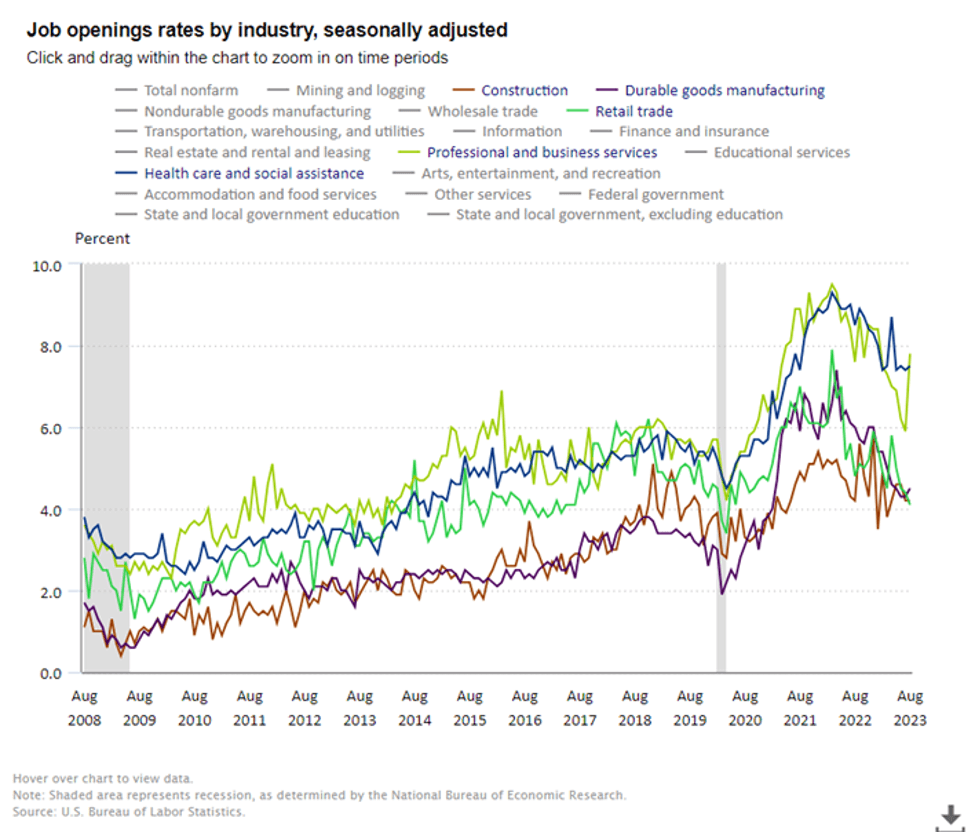
Source: Bureau of Labor Statistics
A host of new technologies, currently in the pilot stage, may soon be ready for industry deployment at scale. Those include AI, robotics and the blockchain. In particular, there are huge advances underway in large language models, generative AI, collaborative robots, the industrial internet of things, cloud-based software, autonomous vehicles and advanced sensing. And there’s an equally impressive list of technologies now transitioning from academia to industry will be available in the coming five to 10 years, that will further increase productivity while qualifying American workers for positions commanding higher pay and entailing greater responsibilities.
The Impact on the Economy
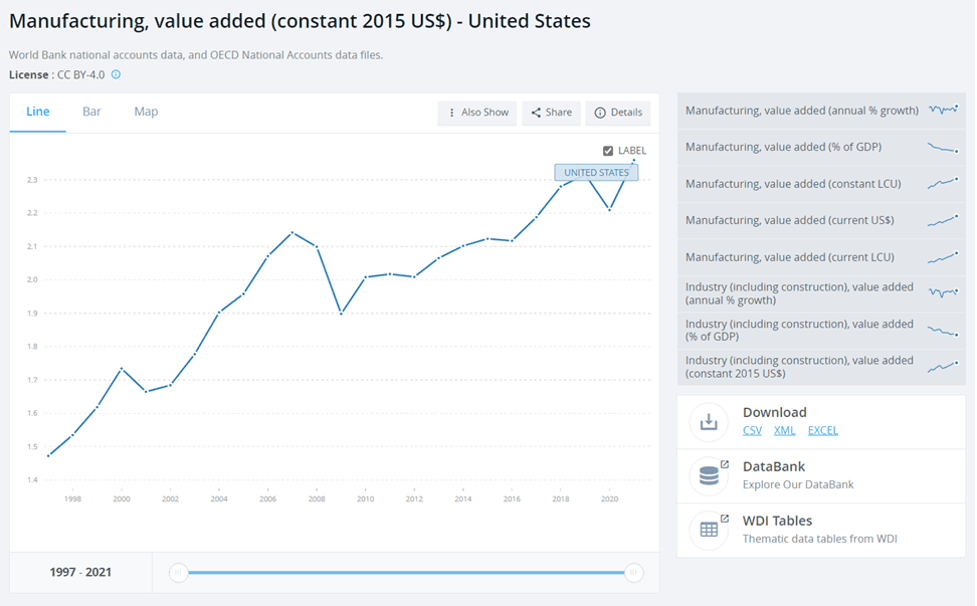
Image from https://data.worldbank.org/
From this chart, we can see that from 2009 to 2022, manufacturing capacity grew from $1.9 trillion to $2.3 trillion in the U.S., $175 billion to $204 billion in Canada, and $160 billion to $222 billion in Mexico. The overall growth of manufacturing among these three countries was 22% and $491 billion over 13 years (with inflation removed from the figures).
Forward-looking and human-facing technology will go far in helping to close the geopolitical and economic gaps we’re now facing, while allowing the current surge in North American manufacturing to not only grow, but even exceed forecasts.
With care and a strong focus on both technology and human potential, I believe the future of the industry is bright.
Matthew Chang, PE
Founder
Matthew founded Chang Robotics in 2017 and brings two decades in advanced manufacturing, with engineering projects across 20 disciplines.
Keep Reading
Related Articles
 01
America can manufacture at cost-parity with China
Automation shrank labor’s share of unit cost, which changes what the US is competing on. Matthew Chang on why parity with China is reachable, and what has to be true about the workforce for it to happen.
Oct 20, 2026Read → 02
Nobody Is Building a New Plant Without Automation (Matthew Chang on Cheddar)
Matthew Chang on Cheddar: automation used to need a financial justification, and in 2026 it is the base case. What that changes about new plants, and about who works in them.
Oct 13, 2026Read → 03
There Is Not Enough Skilled Labor for the Factories Being Built (Matthew Chang with Jane King)
Every industry vertical is expanding at the same time, the skilled workforce to staff those plants does not exist in the numbers required, and supply chains are stretching. Matthew Chang’s advice to any manufacturer weighing automation is to get the plan lined out now, because the speed at which you move is a decision you can make later.
Oct 13, 2026Read →
Done Reading? Let's Talk About Your Floor.
Tell us what you're trying to solve. We'll tell you what automation can and can't fix.